

27.09.2023
Batteries and UPS systems are critical technologies that ensure uninterrupted data center operation in the event of a power outage. In this interview, we spoke with Karel Šebelík about the objectives and design considerations behind these systems.
I have been working at Altron for the past three years as a consultant. My main passion—electrical engineering—began during secondary school and continued at the Czech Technical University in Prague. My first job was at the Research Institute of Air Handling Technology, where I developed and tested HVAC and air-conditioning systems, an area I continue to work with at Altron.
Later, my career shifted more toward IT, where I held both technical and managerial positions. I previously worked for companies such as Komerční banka and Siemens IT Solutions and Services. From the perspective of what we do at Altron today, my most significant experience was at J&T Bank, where I was responsible for building data centers for the entire J&T financial group. That was where I became familiar with a number of non-IT technology suppliers, including Altron, which at the time delivered generators, UPS systems, and batteries for the bank’s data center.
When I retired, I realized I was not quite ready to stop working. I contacted Altron—my former supplier—and joined the company three years ago. I am very pleased with that decision. My current colleagues are outstanding technology experts, and we know each other from previous joint projects.
While they often approach topics from a highly technical design perspective, I bring experience from the client side—as a data center customer and operator. That operational insight represents significant added value for our team.
At Altron, I collaborate across all divisions, but primarily during the proposal preparation phase. When bidding for projects, I contribute to the overall solution design and participate in the selection process for subcontractors.
One of my major projects was the construction of the Nagoya data center for Seznam.cz in Benátky nad Jizerou. I was responsible for subcontractor selection, commissioning, supervision of trial operations, troubleshooting, and identifying root causes of issues. This was followed by the development of the Kokura data center in Horní Počernice. In addition, I work on smaller projects for public administration bodies, hospitals, and similar institutions.
For IT and communication technologies, two elements are absolutely critical: power supply and cooling. Of course, other areas such as security and fire protection are also important, but power and cooling are fundamental.
If a computer loses power—even for just a few milliseconds—it shuts down improperly, interrupting all data and running processes. In a data center with hundreds of servers, such an interruption can have serious consequences. Restoring systems to their original state may take hours or even days, and in many cases, full recovery is not entirely possible.
For this reason, every data center requires an uninterruptible power supply (UPS). A UPS provides power during an outage until grid power is restored or backup generators start up. However, it can only do so using energy stored in batteries. Batteries are therefore a crucial technology that ensures continuous power supply during unexpected events.
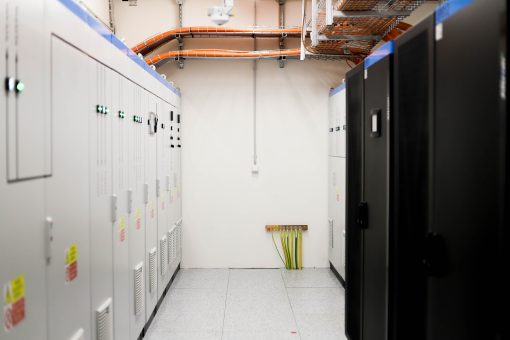
Poměrně dlouho se pro UPS zdroje používaly baterie olověné. Ty znamenaly osvědčenou technologii s rozsáhlou sítí výrobců, z nichž si může zákazník vybírat. Mají však slabé stránky, které se do moderního konceptu bezpečného zálohování datového centra nehodí.Jedna z jejich nedobrých vlastností je, že nejsou příliš spolehlivé a mají krátký životní cyklus. Reálná životnost olověných baterií je 5 let, v nevhodných provozních podmínkách ale vydrží pouhé 3 roky. Musí se proto často měnit, což nese dodatečné náklady servisu, komplikace s výpadkem baterií při výměně a logisticky náročnou manipulaci. Další problematická vlastnost je, že potřebují teplotu kolem 20 °C. Proto se musí místnosti s bateriemi klimatizovat, což vyžaduje další investiční a provozní náklady.
Pro datacentra jsou vhodnější baterie na bázi fosfátu lithia a železa. Jsou velmi bezpečné a v porovnání s olověnými bateriemi vykazují zhruba 3x vyšší hustotu energie.
For many years, lead-acid batteries were commonly used in UPS systems. They represented a proven technology with a wide network of manufacturers. However, they have significant limitations that do not align well with modern data center resilience concepts. One drawback is their relatively short lifecycle and lower reliability. The real-world lifespan of lead-acid batteries is typically around five years, but under suboptimal operating conditions, it can be as little as three years. This necessitates frequent replacement, resulting in additional service costs, operational complications during replacement, and complex logistics due to their weight. Another limitation is their temperature sensitivity. Lead-acid batteries require an operating temperature of approximately 20°C, meaning battery rooms must be air-conditioned—adding both capital expenditure (CAPEX) and operating expenditure (OPEX). For data centers, lithium iron phosphate (LiFePO₄) batteries are a more suitable alternative. They are extremely safe and offer approximately three times higher energy density compared to lead-acid batteries.
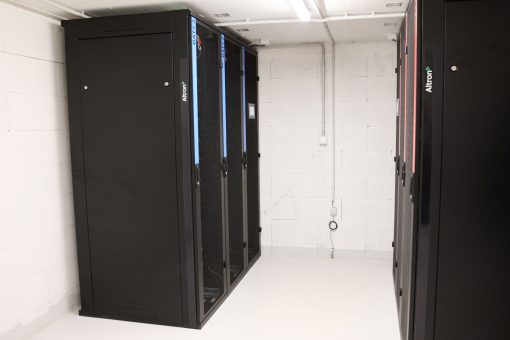
The goal is to select batteries that provide the highest possible energy capacity within the smallest possible footprint. Recently, lithium-ion (Li-ion) battery technologies have seen the most rapid development. However, there are several types, each with different characteristics.
Battery chemistries differ primarily based on the cathode material. Manganese- or cobalt-based cathodes are popular due to their very high energy density, making them ideal for mobile devices. They are lightweight and offer long runtime, but under high temperatures, mechanical damage, or improper charging, they may pose a fire risk.
For data centers, lithium iron phosphate (LiFePO₄) batteries are more appropriate. They are significantly safer and provide approximately three times higher energy density than lead-acid batteries.
Imagine building a data center inside an office building and being able to choose whether the batteries occupy three rooms or just one. Another important advantage is weight. Lead-acid batteries may require structural floor reinforcement. With LiFePO₄ batteries, this issue is largely eliminated.
Naturally, the upfront investment differs. LiFePO₄ batteries typically cost approximately twice as much as lead-acid batteries. However, when evaluating total cost of ownership (TCO), LiFePO₄ solutions are significantly more economical. Their lifespan reaches several decades, compared to approximately five years for lead-acid batteries. Another major cost factor is operating temperature. LiFePO₄ batteries typically operate within a range of 0°C to 50°C. In extreme applications, such as military use, they can function from -20°C to 60°C. They therefore require little to no air conditioning and are highly economical to operate. Over the long term, lead-acid batteries cannot compete with LiFePO₄ in terms of overall efficiency and cost-effectiveness.
Organizations focused primarily on minimizing upfront costs and willing to accept lower reliability and higher long-term costs may still choose lead-acid batteries. However, those who consider the long-term operation of a data center, seek higher reliability, longer service life, and lower operating costs, choose LiFePO₄. Altron positions itself as a pioneer of modern technologies. In projects such as the Nagoya data center and others, we actively explain to clients why LiFePO₄ technology represents a substantial benefit and a forward-looking solution. We aim to deliver the optimal solution, and in general, our clients trust our expertise and value our recommendations—which I consider one of our strongest credentials.

THE Art of Engineering


